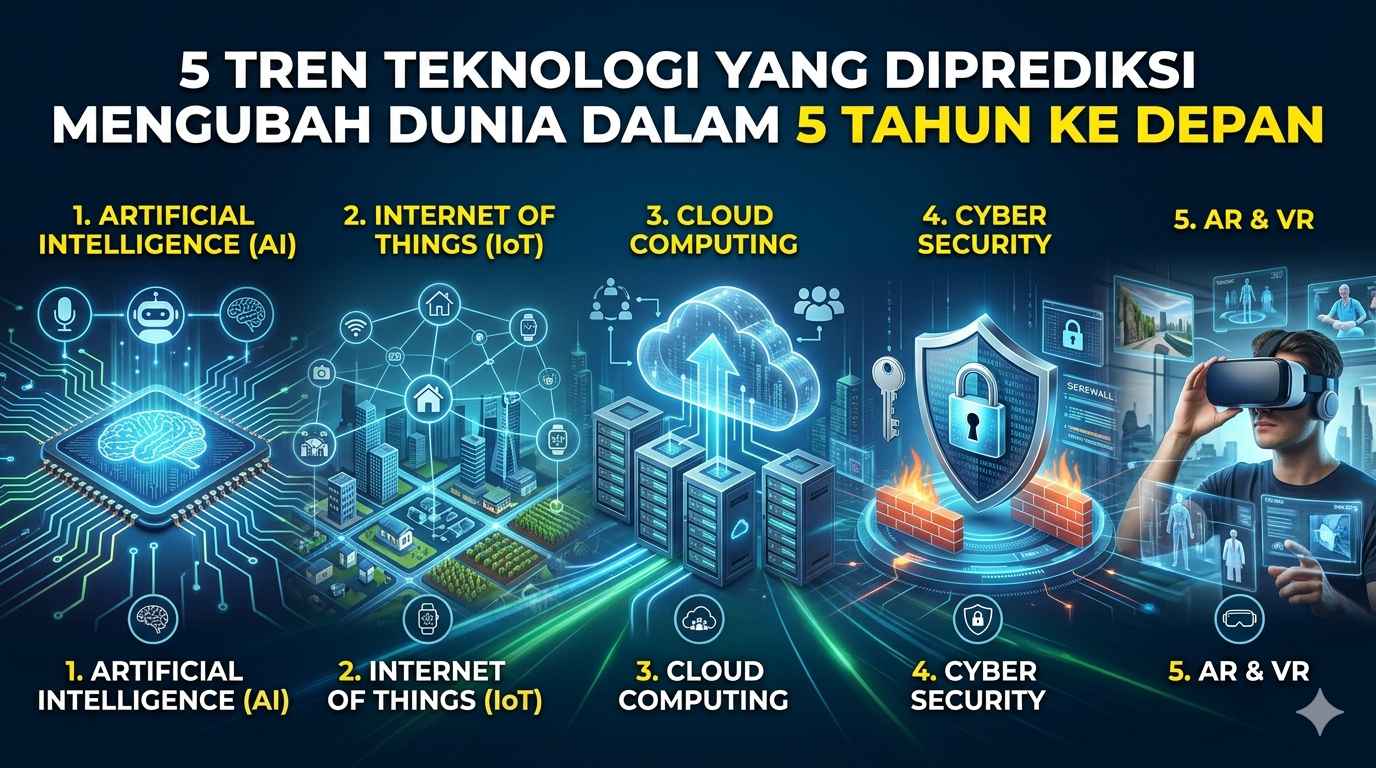
Technological developments continue to move very quickly. Things that were once considered impossible are now starting to become part of everyday life. In the next few years, various innovations are predicted to increasingly influence how humans work, learn, communicate, and even run businesses.
So, what technologies are expected to bring major changes in the future? Here are 5 technology trends predicted to change the world in the next 5 years.
1. Artificial Intelligence (AI) Will Increasingly Dominate
Artificial Intelligence or AI is one of the fastest-growing technologies today. AI allows computers and digital systems to mimic human capabilities, such as understanding language, recognizing images, and even making decisions.
Currently, AI is already used in:
- Chatbots and virtual assistants
- Social media content recommendations
- Automatic translators
- Digital security systems
- Business data analysis
In the next few years, AI is predicted to become even more integrated into everyday life, including in education, healthcare, transportation, and the creative industries.
Despite bringing many benefits, the development of AI also raises new challenges, such as changes in job types and digital data security.
2. Internet of Things (IoT) Makes Everything "Smart"
The Internet of Things (IoT) is a concept where devices can connect to each other via the internet and exchange data automatically.
Examples of IoT technologies that are starting to be widely used:
- Smart home lighting
- Smartwatches
- Online security cameras
- Digital agricultural sensors
- Smart home appliances
In the future, IoT is predicted to continue growing and help various sectors work more efficiently, including agriculture, healthcare, logistics, and smart cities.
Imagine a home that can automatically turn on lights, vehicles that can warn of danger, or agricultural systems capable of monitoring plant conditions in real-time.
3. Cloud Computing Will Become the Foundation of the Digital World
Cloud computing allows data and applications to be stored on the internet, not just on personal devices.
This technology allows users to:
- Store files online
- Access data from anywhere
- Collaborate in real-time
- Reduce the use of expensive hardware
Services such as online storage, virtual meetings, and modern work applications mostly already use cloud technology.
In the next 5 years, cloud computing is expected to become the backbone of the digital transformation of various companies and public services.
4. Cyber Security Will Become a Top Priority
The continuous development of digital technology also increases the risk of cybercrime. From data theft and online fraud to ransomware attacks, these have become increasingly serious threats.
Therefore, cyber security is predicted to become one of the most important technology fields in the future.
Companies and internet users will increasingly need:
- Personal data protection
- Network security systems
- More secure authentication
- Digital security education
Digital security is no longer just the responsibility of large companies, but has also become a necessity for every internet user.
5. Augmented Reality (AR) and Virtual Reality (VR) Technologies Will Become More Popular
AR and VR are technologies that combine the real world with the digital world interactively.
Examples include:
- Social media camera filters
- VR game simulations
- Virtual tours
- Digital simulation-based training
In the future, these technologies are expected to be used not only for entertainment but also in:
- Education
- The medical world
- Architecture
- Business and marketing
Digital experiences will feel increasingly real and interactive thanks to the development of AR and VR.
Conclusion
Technology will continue to develop and bring major changes to human life. Artificial Intelligence, Internet of Things, Cloud Computing, Cyber Security, as well as AR and VR are predicted to be the most influential technologies in the coming years.
These changes certainly bring new opportunities, both for individuals and businesses. Therefore, understanding technological developments from now on can help us be better prepared to face an increasingly advanced digital future.